
Digital transformation in the packaging industry! Food label compliance enters the AI era
At a presentation session hosted by the Guangdong Food Safety Society, INNOPACKING introduced the Packaging Governance Maturity Model and explained how AI's intelligent compliance audit can address the batch redesigns introduced by GB 7718-2025.
On June 26,2026, under the guidance of the Guangdong Provincial Health Commission, the Guangdong Food Safety Society and the Guangdong Provincial Institute of Public Health jointly hosted the "Technical Exchange and Sharing Session on Compliance with Prepackaged Food Labeling and AI Intelligent Review Technology" at the Guangzhou Sanyu Hotel. The event attracted more than 140 industry representatives from food production, operation, testing, and other sectors across the province, who engaged in in-depth discussions on food labeling compliance and digital transformation.
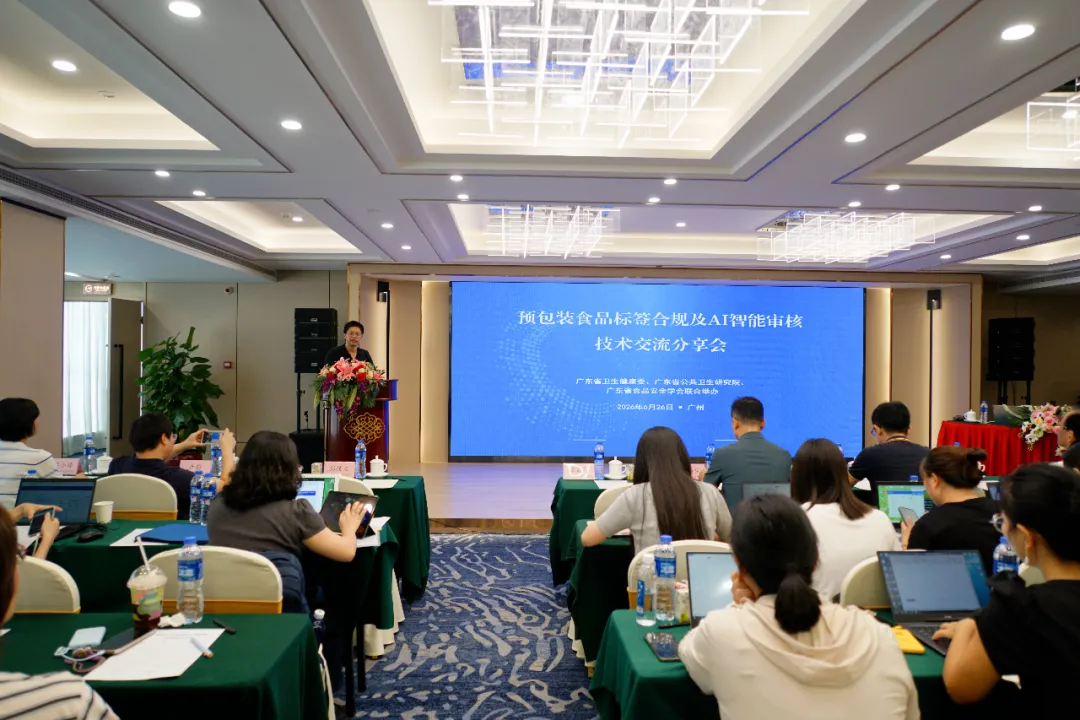
Huang Huan, Deputy Secretary-General of Guangdong Packaging Technology Association and representative of the Guangdong Packaging Technology Association Innovation Center (INNOPACKING), delivered a keynote presentation titled "The Digital Pathway for Food Label Review Management—AI Intelligent Compliance Audit Solution" at the meeting. The presentation extended its perspective to end-to-end governance throughout the packaging development process, resonating strongly with the participating enterprises.

I. Addressing Industry Pain Points: The Challenges of Traditional Manual Review Models
During the sharing session, Deputy Secretary-General Huang Huan first analyzed the current challenges facing the food labeling review industry. With the new edition of the *National Food Safety Standard—General Rules for the Labeling of Prepackaged Foods* (GB 7718-2025) set to take effect on March 16,2027, the food industry has fully entered the countdown phase for label redesign.
However, the challenges facing food companies go far beyond simply "changing a single label."
- Batch overhaul: comprehensive revision of the nutrition facts table and simultaneous deployment of digital labels;
- Channel differentiation: retail, e-commerce, catering, and B2B channels each have distinct packaging formats;
- Collaborative complexity: multiple stakeholders—including regulators, the market, packaging providers, and suppliers—operate concurrently;
- Implementation risk: The version approved for review may be Draft A, while the version used for production may be Draft B.
The real challenge lies not in proofreading a single document, but in handling multiple workflows simultaneously. The traditional approach, which relies on manual item-by-item review, has become inadequate in terms of both efficiency and coverage. At the same time, the differing requirements of retail, e-commerce, catering, and other channels regarding the presentation of packaging information have made it no longer feasible to apply a single review logic across all scenarios.

Moving beyond abstract discussion, Deputy Secretary-General Huang Huan shifted the focus back to the actual packaging development process and analyzed the typical risks associated with several niche segments:
- Dairy/Beverages: The nutrition facts tables have undergone a comprehensive overhaul; adjusting a single field often impacts the consistency across product lines spanning multiple brands and specifications;
- Snack foods: the stronger the positive selling point, the more pronounced the "triangular relationship" between the supporting ingredients and the quantitative labeling; the stronger the selling point, the longer the chain of compliance audits required.
- Seasoning/Catering version: The retail version and the B2B version operate in parallel, with different information-carrying mechanisms; therefore, their review logic cannot be shared.
- Digital labeling: QR codes are not merely marketing entry points; physical packaging and the corresponding scan pages must be version-bound.
These scenarios highlight a long-overlooked issue: compliance audits cannot be conducted in isolation from the packaging development process. The areas most prone to error are often not the interpretation of regulatory provisions, but the information gaps at the points where processes intersect.
II. AI: Breaking the Mold – A Comprehensive Solution for Intelligent Compliance Review – PACKFLY
Food packaging compliance is evolving from "reviewing a single draft" to "managing a suite of packaging assets."
In the past, companies relied on compliance personnel to conduct manual, item-by-item reviews; today, compliance, packaging, marketing, and suppliers must all participate jointly; and looking ahead, full-chain traceability across standards, processes, documents, samples, and signatures will become a fundamental requirement.
In other words, what enterprises need is not merely a one-time approval of their review process, but the establishment of a batch-processing, collaborative, traceable, and reusable packaging governance system.
Under this approach, the Guangdong Packaging Technology Association Innovation Center (INNOPACKING) was the first in the industry to propose a packaging governance maturity model, enabling enterprises to conduct self-assessment:
- Level 1 Packaging implementation: supplier-driven, fragmented documentation, reliance on personal experience → prioritize compliance review, finalization, and archiving;
- Level 2 Packaging Management: Existing team processes are in place, but pressure related to SKU and version control is increasing → Prioritize process and asset management;
- Level 3 Packaging Governance: Multiple brands, multiple factories, and multiple channels operating in parallel → unified standards, access controls, evidence chains, and reuse mechanisms.
Huang Huan, Deputy Secretary-General, suggested that enterprises could use this to assess their current stage and prioritize addressing their most urgent shortcomings—whether by strengthening proofreading and archiving, optimizing processes and asset management, or establishing a full-lifecycle governance framework.

III. Review is not the endpoint; successful mass production is what closes the loop.
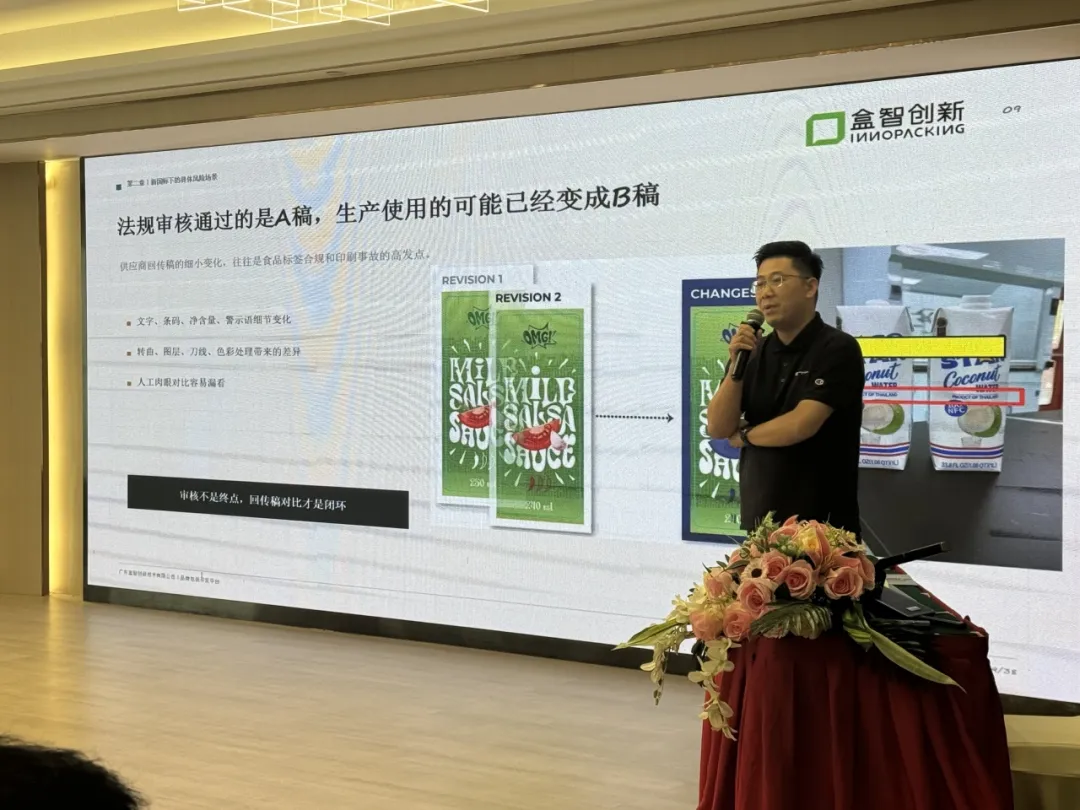
One perspective that deserves particular attention in this discussion is that while the regulatory review approves Draft A, the version that actually enters production may be Draft B.
Minor variations in supplier-submitted drafts—subtle differences in text, barcodes, net content, and warning statements—as well as changes introduced by bending, layering, and color processing, are often the primary sources of label compliance incidents.
Deputy Secretary-General Huang Huan pointed out that review is not the endpoint; only the confirmation of consistency between the returned draft and the review draft constitutes a closed loop. In this regard, the auxiliary comparison capability of PACKFLY can likewise play a role by bringing differences that are difficult to detect consistently by the human eye forward for system identification and recording.
Moreover, label review is only the first step; the packaging must ultimately be correctly manufactured. Between the approved draft and the production documentation ready for mass production, there are additional engineering stages, including final document processing, color management, and process breakdown. From design renderings to actual shelf presentation, the process also requires material verification, sample confirmation, functional testing, and sample signing and label locking; only then can it be ensured that "this time it was done correctly" and that "it will continue to be done correctly in the future."
Finally, Deputy Secretary-General Huang Huan offered two practical suggestions to the participating enterprises:
First, begin with key SKU pilot projects. There is no need to pursue full coverage in a single phase; instead, it is recommended that you first select 10 to 30 high-risk or high-volume core SKU cases, successfully implement the complete workflow from review to deployment, and then gradually replicate this process across the full asset base. The batch-processing capability of AI for auxiliary review can effectively support efficiency requirements during the pilot phase.
Second, transform the revision process into reusable assets. The implementation of the new regulations presents a challenge, but it also provides an opportunity for enterprises to upgrade their packaging management systems. Each audit record, each comparison of supplier submissions, and each time a sample is signed off and the standard is finalized, creates a governance template that can be reused in the future, rather than constituting a one-time human-resource cost.
IV. Concluding Remarks
The AI Intelligent Compliance Review Solution is not merely a technical tool; it represents an entirely new approach to compliance management.
It upgrades the traditional "person-to-person" review model to a "human–machine collaboration" intelligent management model, thereby reducing labor costs and improving review efficiency while effectively enhancing the precision and coverage of compliance management.
For food enterprises, this means a shorter time-to-market cycle for labels, lower compliance management costs, and enhanced risk prevention and control capabilities—during the critical window for label redesign, this is undoubtedly a timely relief.
The Guangdong Packaging Technology Association Innovation Center (INNOPACKING) will continue to leverage its advantages as an industry platform, focusing on packaging compliance audits, development process governance, and mass-production implementation capabilities; actively explore the compliant application of new technologies such as AI in the packaging sector; provide Guangdong food enterprises with end-to-end empowerment spanning from regulatory interpretation to mass-production delivery; and help the industry advance steadily and sustainably amid the digital transformation wave.
This article has been compiled and archived based on posts from the company's official WeChat account; the full text and accompanying images are published on this website.